Marsnut← Back to Home

Respiration Powerhouse

Respiration Powerhouse cover

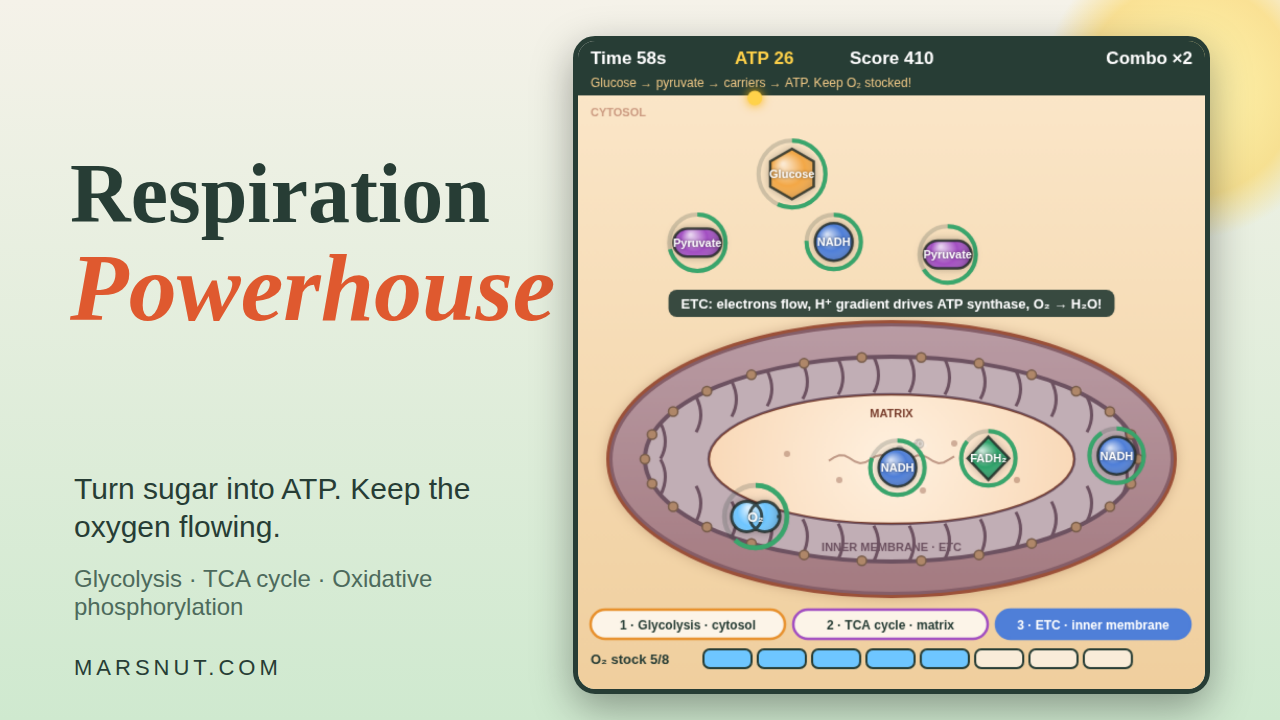
Turn sugar into ATP in 90 seconds. Drag each molecule into the right compartment: glucose → cytosol (glycolysis), pyruvate → matrix (TCA cycle), NADH, FADH₂ and O₂ → inner membrane (electron transport chain). Or tap a compartment to send the most urgent molecule. No O₂ means the chain stalls! (Simplified yields.)

Drag molecules (mouse cursor moves extra fast) into a compartment, or tap a compartment / press keys 1-3 to route the most urgent molecule.

90 seconds of active play. P: pause. H: guide. Timers, points, pools, token arrivals and expiry are game mechanics; drawings are not to scale.

For the curious at heart. A pocket-sized collection of science-inspired games.
Made for a quick break, a little discovery, and one more round.

DESKTOP / TABLET / MOBILE · Your browser is your playground.

How to Play Respiration Powerhouse

Drag a molecule to its compartment, or tap a compartment / press 1–3 to route the most urgent molecule. Glucose goes to the cytosol; pyruvate goes to the mitochondrial matrix for pyruvate oxidation and the TCA cycle; NADH, FADH₂ and O₂ go to the inner membrane. Electron transport builds a proton gradient, and ATP synthase uses the gradient to make ATP. Oxygen is the final electron acceptor. One pyruvate produces four NADH and one FADH₂ across pyruvate oxidation and the TCA cycle, plus one ATP/GTP equivalent. Cytosolic NADH transfers reducing equivalents through shuttles; dragging it to the membrane represents that transfer.

Oxygen stock and carrier yields are simplified gameplay accounting, not a prediction of cellular ATP output. Approximate carrier yields are 2.5 ATP per NADH and 1.5 per FADH₂; actual output varies. Pause and help freeze the experiment. The illustration simplifies molecules, enzyme steps and rates.

Read the biology · NCBI Bookshelf