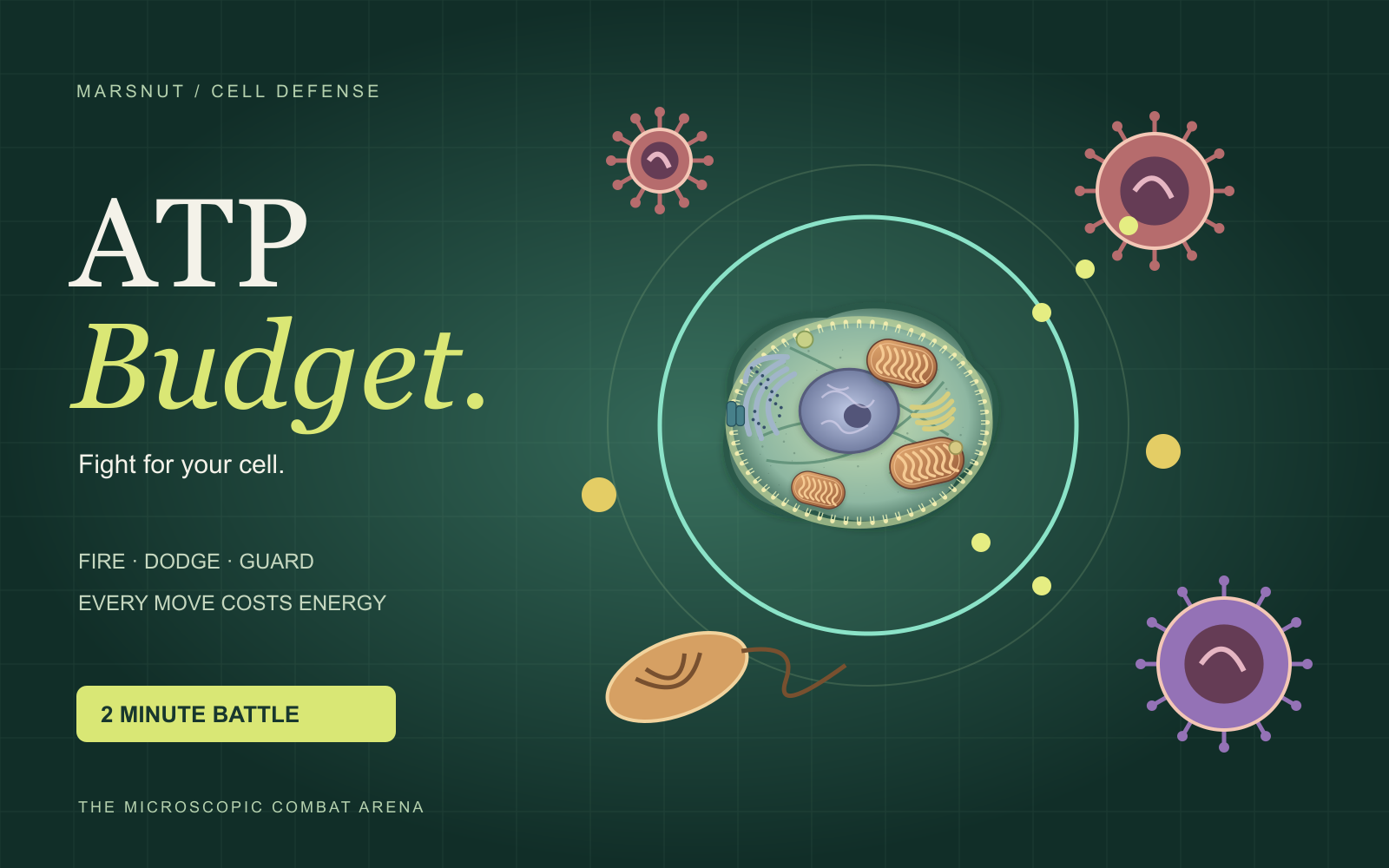
Dodge incoming foes, fire defense pulses, guard against hits, and dash out of danger. Every combat action draws on your ATP budget.
2 MINUTESFIGHTING · CELL DEFENSE
Fast mouse movement, keyboard, or touch controls.
Combat is a visual metaphor: real cells do not shoot pulses or deploy energy shields.
Fire. Dodge. Guard. Budget your ATP.
LIVE COMBAT / CELL DEFENSE
ATP Budget
2:00
ATP reserve60
Cell condition100%
Defense charges8 / 8Guard 60%
Foes defeated0Fuel 100%
Steady stateWAVE 1 / 6
Battle paused — choose Resume.
Move and hold Fire to fight. Closest foe is targeted.
Mouse: move to guide the cell, hold click to fire. Touch: drag in the arena and hold Fire. Keyboard: WASD / arrows move, Space fires, E guards, Shift dashes.
ENERGY AND BIOLOGY
Combat pulses, guard shields, charges, ATP units, damage, and instant controls are game mechanics. Transport supports guard recharge; biosynthesis replenishes defense charges; movement allocation increases speed; repair supports condition recovery.
P pause · H help · M sound · F fuel · R normal output · T higher output. Keys 1–4 select an ATP slider; + / − adjust it.
CELL DEFENSE / BATTLE REPORT
Battle complete
0
Combat score / 100
Your battle ledger
Energy demand through the battle
Score: up to 60 points for 30 defeated foes, 25 for surviving 120 seconds, and 15 for final condition scaled by duration. Combat is an educational metaphor, not a model of immune-system performance.
✳
For the curious at heart. A pocket-sized collection of science-inspired games. Made for a quick break, a little discovery, and one more round.
DESKTOP / TABLET / MOBILE Your browser is your playground.